Roughly one in three adults regularly falls short on sleep, and most of us treat it like background noise: something we complain about, plan to fix “next week,” and never actually address. The frustrating part is that sleep follows predictable biology, and small, consistent changes can shift it noticeably within days. This guide gives you one focused week: a day-by-day plan grounded in sleep science, with actions that take minutes and pay off in mornings that feel different.

The Science of Sleep, Simplified
You don’t need a physiology degree to sleep better. But knowing the machinery helps, because every habit in this plan targets a specific lever. Here are the essentials.
Your Circadian Rhythm Is the Boss
Deep in your brain, a cluster of cells called the suprachiasmatic nucleus acts as your internal clock. This circadian rhythm runs on a roughly 24-hour cycle and decides when you feel alert and when you feel sleepy. It’s set by cues — mainly light, meal timing, and activity — which is why habits beat hacks. Consistent cues mean a smooth clock; chaotic ones give you a groggy, jet-lagged feeling without ever leaving home.
- **Consistency matters more than perfection:** the clock anchors to patterns, so a steady wake time beats any single “great” night.
- **Your rhythm is slightly longer than 24 hours:** without strong light cues it drifts late, which is why weekend lie-ins make Monday mornings brutal.
Sleep Cycles: Why 90 Minutes Matters
Sleep isn’t one continuous state. Your brain cycles through light sleep, deep sleep, and REM (dream) sleep in roughly 90-minute loops, repeating four to six times a night. Deep sleep does the physical repair work; REM handles memory and emotional processing. Waking at the end of a cycle feels easy; being dragged out of deep sleep mid-cycle feels awful. Aim for full cycles (7.5 or 9 hours rather than 7 or 8.5) to stack the odds in your favor.
- **Not all hours are equal:** the first deep-sleep-heavy cycles early in the night are the most restorative.
- **Fragmented sleep breaks cycles:** each interruption can restart a cycle, so five interrupted hours feel far worse than six consolidated ones.
Melatonin, Light, and Caffeine
Your brain starts releasing it when light fades — which is why bright evenings and glowing screens can delay it. On the other side of the ledger sits caffeine, with a half-life of roughly five to six hours: a 2 PM coffee still has about half its caffeine in your system at 8 PM, and a quarter of it around 2 AM.
- **Morning light is a wake signal:** bright daylight within an hour of waking tells your clock “it’s morning,” which also helps melatonin release on time that evening.
- **Dim the evenings:** lamps over overheads, warmer bulbs, and screens turned down make the melatonin rise easier.
- **Caffeine curfew:** no caffeine after early afternoon. If you need an evening ritual, make it caffeine-free.
Blue Light: The Small Culprit
It’s not that blue light is evil — daylight is full of it. The problem is timing: bright, blue-rich screen light in the late evening tells your brain it’s still afternoon, pushing melatonin release later. This is one reason phone-scrolling in bed keeps people up past their intentions. The screen off matters more than the filter on.
- **Night mode helps but doesn’t solve:** dimming and warmth filters are better than nothing, but putting the device down wins.
- **One hour before bed:** make screens-off the default, and treat exceptions as exceptions.
- **Charge the phone outside the bedroom:** removes the strongest temptation at the weakest moment of willpower.
Why “Catching Up” Fails — and What Actually Works
The Sleep Debt Myth
Most of us run a sleep deficit during the week and try to repay it on Saturday with a three-hour lie-in. It feels good, but the math doesn’t work: one or two long weekend sleeps don’t reverse the effects of a week’s short nights. Worse, the lie-in shoves your circadian clock later — “social jet lag” — so Monday’s early alarm hits like a time-zone change. You can pay down a mild debt slightly, but you can’t binge your way back to rested.
- **Stop borrowing:** treat weeknights as non-negotiable; weekend recovery is a bonus, not a plan.
- **Cap weekend lie-ins:** sleep in no more than about an hour past your normal wake time.
- **Think average, not total:** a steady 7.5 hours nightly beats 5 + 5 + 5 + 5 + 11.
The Ideal Sleep Environment
Your bedroom should be a cave: cool, dark, and quiet. “Cool” means roughly 65–68°F (18–20°C) — your core body temperature needs to drop to initiate sleep, and a warm room fights that. “Dark” means blackout-level: even small light sources can fragment sleep. “Quiet” means eliminating unpredictable noise; steady white noise is fine.
- **Temperature first:** a cool room with warm feet (socks or a warm bath before bed both help the heat-drop mechanism).
- **Blackout the windows:** curtains or a comfortable sleep mask; cover LED dots on chargers and devices.
- **Sound plan:** earplugs, a white-noise machine, or a fan — anything that masks sudden sounds.
- **Bed = sleep:** keep the bed for sleep (and intimacy) only, so your brain keeps the association clean.
Days 1–2: Foundations
Day 1: Audit Your Sleep and Fix Your Wake Time
Day 1 is about an honest snapshot: tonight, jot down when you woke today, how many times you woke in the night, when you had caffeine, and when screens went off. Then pick a fixed wake time — one you can keep seven days a week — and set it starting tomorrow. The wake time is the anchor of the entire plan; bedtime will drift toward it naturally once the rhythm settles.
- **Choose a wake time you can actually keep:** within about 30 minutes of your current average, so it’s a nudge, not a shock.
- **Set the alarm across the room:** the walk wakes you more effectively than a second alarm.
- **Write tonight’s one-line audit:** wake time, caffeine cutoff, screen-off time, perceived quality 1–5.
- **Tell someone:** saying the wake time out loud to a partner or friend makes it stickier.
**Your small win to notice:** getting up at the same time on Day 2 morning without feeling dramatically worse than usual — the anchor is in.
Day 2: Morning Light and a Real Routine
Yesterday set the anchor; today feeds the clock its strongest cue. Get bright light — ideally daylight — within the first hour of waking: ten to fifteen minutes outside on a sunny day, or twenty to thirty minutes near a window on gray days. Then build a short morning routine that gets your body moving and your stomach fed, because movement and food are secondary time-setters for the clock.
- **Light before screens:** step outside or open the blinds before reaching for the phone.
- **Move for ten minutes:** a walk, some stretching, bodyweight squats — anything that raises your heart rate a little.
- **Eat within an hour or two:** breakfast (or your first meal) tells the gut clock that the day has started.
- **Make the bed:** a small completed task sets a “day is on” signal and gives you a tidy bed tonight.
**Your small win to notice:** feeling a genuine wave of sleepiness around your target bedtime tonight — that’s the clock responding to this morning’s light.
Days 3–4: Caffeine Curfew and the Bedroom Reset
Day 3: Set a Caffeine Curfew and Build a Wind-Down
Today’s job is cutting off the stimulant and installing an off-ramp for your brain. With caffeine’s five-to-six-hour half-life, a cutoff around 12–1 PM works for most people targeting a 10–11 PM bedtime; if you’re sensitive, push it to 11 AM. Replace the afternoon cup with a ritual that doesn’t fight your evening self — a short walk, herbal tea, or a glass of water outside for five minutes. Then design a 30–45 minute wind-down sequence you can repeat nightly: same steps, same order, ending in bed. Repetition is the point — the sequence becomes a signal for sleep.
- **The curfew rule:** nothing caffeinated (coffee, tea, energy drinks, chocolate-heavy desserts) after your cutoff; check labels, since some teas and sodas hide caffeine.
- **Three-step wind-down example:** 20 minutes of light stretching or reading, 10 minutes of dim-light tidying (layout tomorrow’s clothes), 5 minutes in bed with slow breathing.
- **Slow breathing that works:** inhale 4 counts, exhale 6–8 counts, for about two minutes — longer exhales activate the calming branch of your nervous system.
- **No “just one more” tasks:** the wind-down is a shutdown sequence, not a productivity slot. Emails wait until morning.
**Your small win to notice:** falling asleep without the wired-but-tired feeling — your head quieter than the last few nights.
Day 4: Reset Your Bedroom
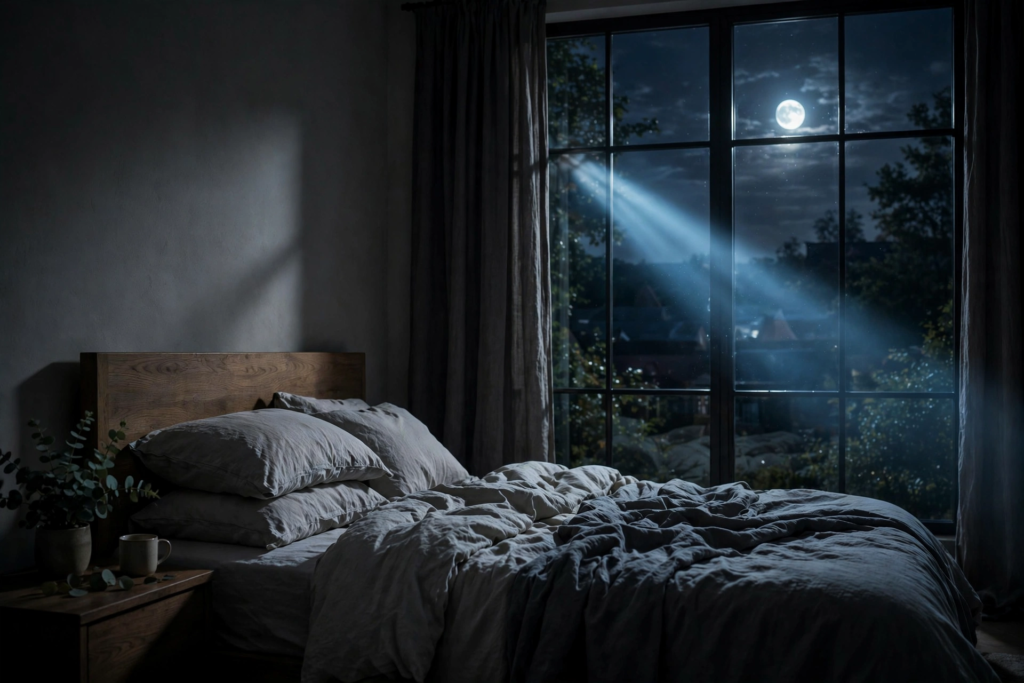
Your sleep environment probably has accumulated compromises: a glowing router, thin curtains, a warm duvet, a phone charging on the nightstand. Day 4 is a one-time reset pass — cool the room (65–68°F / 18–20°C, or as close as your setup allows), darken it fully, silence the unpredictable noises, and evict the phone. This isn’t a remodel — it’s a 20-minute sweep that pays off every night from here on.
- **Light audit:** sit in bed and look for every glowing dot — cover or unplug it. Blackout curtains or a sleep mask handle windows.
- **Temperature lever:** turn the thermostat down an hour before bed, crack a window if it’s cooler outside, or swap to a lighter blanket.
- **Sound plan:** pick your tool tonight — white-noise app on a speaker, earplugs by the pillow, or a fan left on low.
- **Phone eviction:** charger moves to the hallway or another room. Buy a cheap alarm clock if you use the phone alarm as an excuse.
**Your small win to notice:** waking fewer times in the night — or at least noticing how dark and quiet the room feels when you do wake briefly.
Days 5–6: Move, Nap Smart, and Empty Your Head
Day 5: Exercise Timing and the Perfect Nap
Exercise is one of the strongest sleep improvers we know — it deepens slow-wave sleep and shortens the time it takes to drift off. The catch is timing: vigorous workouts within two to three hours of bedtime can leave some people wired. Aim for morning or afternoon movement today; even a brisk 20-minute walk counts. And if you nap, do it right: early afternoon (before about 3 PM), 10–20 minutes, never longer.
- **Best window:** late morning to late afternoon for harder sessions; gentle stretching or yoga is fine anytime.
- **No workout? Walk:** a brisk 20–30 minute walk in daylight doubles as exercise and light exposure.
- **Nap rules:** set an alarm for 20 minutes (you’ll sleep ~15), keep it before 3 PM, and skip it if bedtime is under six hours away.
- **Skip the late gym guilt:** a late workout still beats no workout — just follow it with a hot shower, which helps your core temperature drop afterward.
**Your small win to notice:** that heavy-eyelid, “ready for bed” feeling arriving earlier tonight — physical tiredness you actually earned.
Day 6: Stress Dump Journaling and Screens Off
Racing thoughts are the number-one reported sleep complaint, and they’re beatable with a piece of paper. A “stress dump” — writing down everything on your mind, plus tomorrow’s to-dos — moves the mental loop out of your head and onto a page your brain trusts you won’t forget. Pair it with the full screens-off hour before bed tonight: no phone, no TV, no laptop. Read a physical book, stretch, or sit on the porch instead.
- **The 10-minute dump:** two columns — “on my mind” and “tomorrow’s first three tasks.” Nothing fancy; legibility is optional.
- **The worry rule:** if a thought pops up after the dump, remind yourself it’s on the list and tomorrow’s list has a plan for it.
- **Replace, don’t just remove:** screens-off only works if the replacement is pleasant — pick your book, playlist, or bath in advance.
- **Dim the whole house:** lamps only after dinner. Your home’s lighting is part of the melatonin story.
**Your small win to notice:** the mental chatter volume dropping by bedtime — thoughts still there, but parked on paper instead of circling.
Day 7: Review, Troubleshoot, and Lock It In
Day 7: What Worked, What Didn’t
Pull out your six days of two-minute audits. Which changes made mornings feel different? Most people find two or three levers did the heavy lifting — often the fixed wake time, the morning light, and the caffeine curfew. Double down on those. For what didn’t work, troubleshoot like a scientist: if the wind-down kept collapsing, it was probably too long — shrink it to 15 minutes. If the bedroom reset didn’t stick, pick the single biggest offender (usually the phone) and solve just that one.
- **Keep the audit going one more week:** two minutes nightly is cheap data, and it keeps you honest.
- **Protect the wake time fiercely:** it’s the one habit everything else hangs on.
- **Make the environment permanent:** leave the blackout setup, the phone charger, and the white noise exactly where they are.
- **Write your final three:** one sentence each — “I wake at __, screens off at _, caffeine ends at __.” Tape it to the fridge if that helps.
Troubleshooting Common Snags
Still staring at the ceiling some nights? Even great sleepers have off nights, and watching the clock makes everything worse. If you’re awake more than ~20 minutes, get up, go to another dim room, read something dull, and return when drowsy. If snoring, gasping, or persistent insomnia (trouble sleeping three-plus nights a week for months) is the issue, that’s a doctor’s conversation, not a habit tweak. And if life blows up the routine — travel, illness, a new baby — return to the anchor: fixed wake time first, everything else can be rebuilt around it.
- **The 20-minute rule:** bed is for sleep; if sleep isn’t happening, leave the bed.
- **No clock-watching:** turn the alarm display away. Knowing it’s 3:17 AM helps nothing.
- **One bad night isn’t a relapse:** get up at the same time anyway, get your light, and the rhythm self-corrects.
- **Red flags for a doctor:** loud nightly snoring with pauses, gasping awake, or insomnia that won’t budge after weeks of solid habits.
**Your small win to notice:** a week of data in your own handwriting — proof that your sleep responds to what you do, not to luck.
Frequently Asked Questions
How much sleep do I actually need?
Most adults do best with seven to nine hours, often around 7.5 to 8 — conveniently, five full 90-minute sleep cycles. But the honest answer is personal: if you wake naturally a few minutes before your alarm feeling clear-headed, and you don’t need caffeine to function or naps to survive the afternoon, you’re getting enough. Teenagers need more (8–10 hours). Rather than chasing a number, track how you feel at a consistent wake time — the number reveals itself.
Is it bad to use my phone in bed?
It’s one of the most reliable sleep saboteurs, for three compounding reasons: the bright light delays melatonin, the content keeps your brain alert, and the infinite scroll removes your stopping cue. Night-mode filters soften the light problem slightly but solve nothing about the stimulation. The research-backed move is simple: the phone charges outside the bedroom and the last hour before bed is screen-free.
Can I really not catch up on sleep on weekends?
Mostly, yes — you really can’t, at least not fully. A couple of long weekend sleeps don’t reverse a week’s worth of short nights, and the big lie-in delays your circadian clock, making Monday worse (social jet lag). A modest extra hour is fine and can take the edge off mild debt, but the far better strategy is protecting weeknight sleep so there’s nothing to repay. Think of sleep like a daily vitamin, not a bank account.
What’s the best time to stop drinking caffeine?
Work backward from your bedtime using the five-to-six-hour half-life: you want only a trace left when you sleep. For an 11 PM bedtime, that puts the cutoff around 12–1 PM, and earlier if you’re sensitive to caffeine. Remember hidden sources — black and green tea, many sodas, energy drinks, and even some painkillers contain meaningful caffeine. If you love the afternoon ritual, switch it to herbal tea or decaf; the comfort is the ceremony, not the molecule.
Are naps good or bad for nighttime sleep?
Short, early naps are good; long, late naps are the problem. Ten to twenty minutes before about 3 PM can sharpen your afternoon without touching your nighttime sleep pressure. Past 30 minutes, you drop into deep sleep and wake groggy; past mid-afternoon, you bleed off the sleepiness your bedtime depends on. If you find yourself needing daily naps despite a full night’s sleep, mention it to your doctor — excessive daytime sleepiness can signal an underlying issue.
When should I see a doctor about my sleep?
If poor sleep persists for several weeks despite consistent habits — trouble falling asleep, staying asleep, or waking unrefreshed most nights — book an appointment. Go sooner if you snore loudly with breathing pauses, gasp or choke awake, have an irresistible urge to move your legs at night, or doze off while driving or in conversation. These can be signs of conditions like sleep apnea that need proper diagnosis. This guide covers healthy habits; it doesn’t diagnose or treat disorders.

One week won’t make you a perfect sleeper, and it doesn’t need to. What seven days can do is prove something your tired brain may have stopped believing: your sleep is responsive. A fixed wake time, morning light, an honest caffeine curfew, a dark cool room, and a brain that’s been emptied onto paper — these aren’t heroic disciplines. They’re small, repeatable votes for the version of you that wakes up clear. Keep the three habits that moved the needle most, forgive the nights that wobble, and let the routine do the quiet work. Good sleep isn’t a luxury you earn after everything else is done; it’s the foundation everything else is built on.
The content on Knowlix is for informational purposes only and is not medical advice. Always consult a qualified doctor for health concerns.
Sponsored
