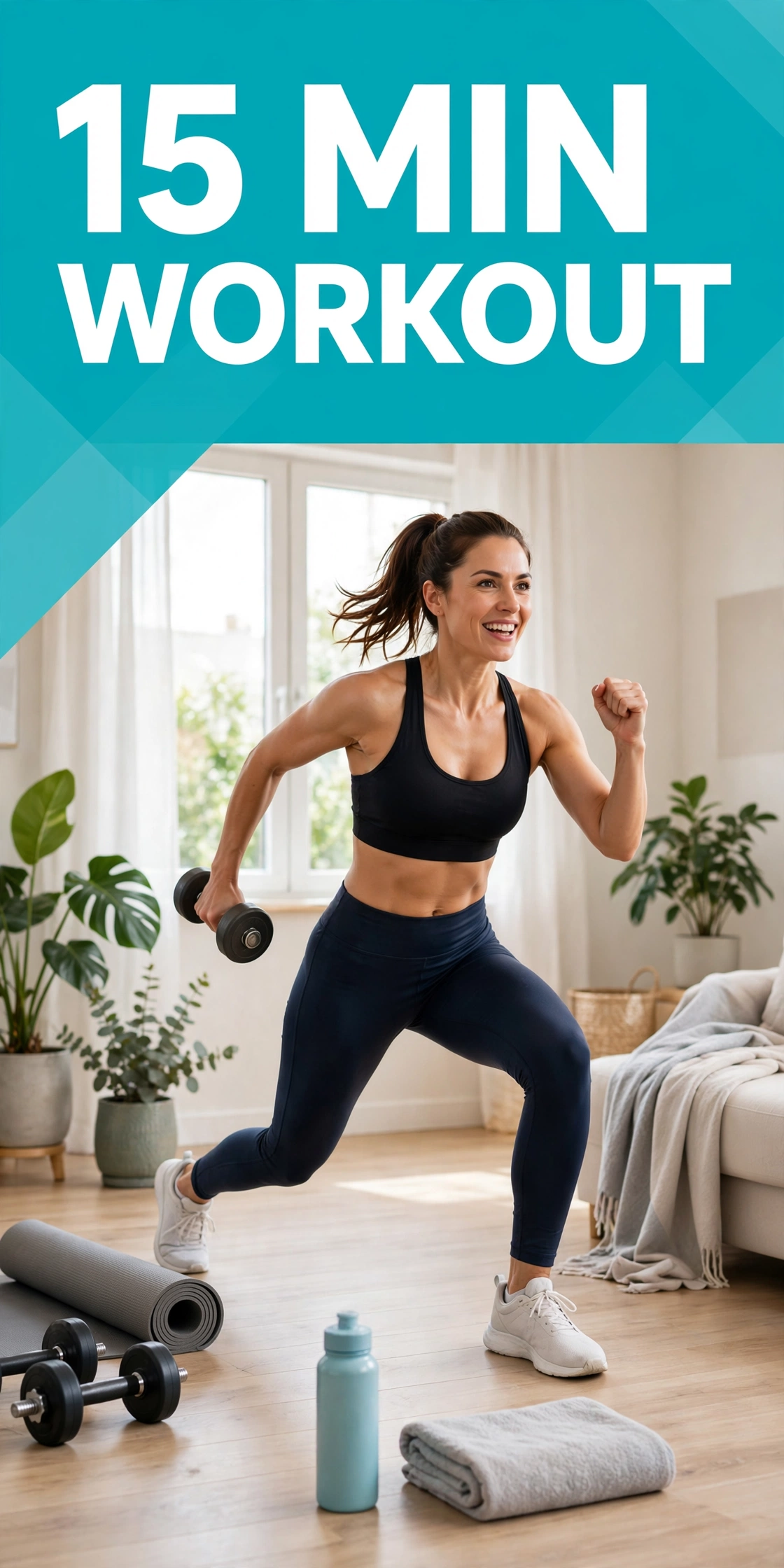
The number-one reason people give for skipping exercise is always the same: “I don’t have time.” Between work, school runs, and everything else, an hour at the gym feels like a fantasy. But here is the truth that changes everything — you do not need an hour. You need fifteen minutes, a little floor space, and the willingness to start.
Research consistently shows that short bouts of exercise deliver real benefits: stronger muscles, a healthier heart, more energy, and even a brighter mood. Your body responds to consistency, not marathon sessions. Three fifteen-minute workouts a week add up to forty-five minutes of training — and that is forty-five minutes more than zero.
Best of all, it fits before your morning shower, during a lunch break, or while dinner cooks — no gym membership, no commute, no special gear.
In this guide, you will get three complete fifteen-minute routines — upper body, lower body, and full body — all bodyweight, all doable in your living room. You will also find a weekly schedule, tips for getting stronger over time, and safety notes so you train smart. Ready? Let us start with why fifteen minutes is genuinely enough.

Why 15 Minutes Is All You Need
Fifteen minutes sounds almost too short to matter — but it sits in a sweet spot. It is long enough to raise your heart rate, challenge your muscles, and build a sweat, yet short enough that “I don’t have time” stops working as an excuse.
Consistency Beats Duration
The best workout is the one you actually do. Most people quit long, ambitious programs within weeks because life gets in the way. A fifteen-minute session you complete four times a week beats the hour-long workout you keep postponing.
- Treat each session like an appointment and put it on your calendar.
- A missed session is easy to reschedule — slide it to tomorrow instead of writing off the whole week.
- Keep a visible streak: a checkmark on a wall calendar or a simple phone note keeps momentum real.
The NEAT Advantage
NEAT stands for non-exercise activity thermogenesis — the energy you burn through everyday movement like walking, fidgeting, and chores. A short morning workout wakes your body up, and people who train briefly tend to stay more active all day.
- Add a ten-minute walk after lunch on training days to stack more movement.
- Stand up and stretch for two minutes every hour if you work at a desk.
- Take the stairs, park farther away, or get off the bus one stop early.
Habit Stacking Makes It Stick
Willpower is unreliable; triggers are not. Habit stacking means attaching your workout to something you already do every day — right after your morning coffee, before your shower, or the moment you get home from work.
- Pick one anchor habit you never skip, and train immediately after it.
- Lay out your workout clothes the night before to remove all friction.
- Use the same time slot every day — within two weeks your body starts expecting it.
Routine 1: Upper Body — Chest, Arms, and Shoulders
This routine builds pushing strength through your chest, shoulders, triceps, and core. All you need is a sturdy chair pushed against a wall so it cannot slide. The structure: a 3-minute warm-up, two rounds of a four-move circuit (45 seconds of work, 15 seconds of rest per move, with a 60-second water break between rounds), a 60-second plank finisher, and a 2-minute cool-down.
Warm-Up: 3 Minutes
- **Arm circles — 30 seconds each direction.** Stand tall and swing your arms in big, controlled circles, forward first, then backward.
- **Shoulder rolls — 30 seconds.** Roll both shoulders up, back, and down in slow circles to wake up the upper back and neck.
- **Cat-cow — 60 seconds.** On all fours, arch your back and tuck your chin on the exhale, then dip your belly and lift your head on the inhale. This mobilizes the entire spine.
- **Standing torso twists — 30 seconds.** Feet hip-width apart, arms relaxed, rotate your trunk side to side, letting your arms swing gently.
The Main Circuit: Two Rounds
Set a timer. Do each move for 45 seconds, rest 15 seconds, then move to the next. After all four moves, rest 60 seconds and repeat the full round.
- **Push-ups — 45 seconds.** Start in a high plank with hands under your shoulders and your body in one straight line from head to heels. Lower your chest toward the floor by bending your elbows to about 45 degrees from your torso, then press back up. Keep your core braced and your hips from sagging. *Make it easier:* drop your knees to the floor, or do wall push-ups standing at arm’s length from a wall.
- **Triceps dips on a chair — 45 seconds.** Sit on the edge of the chair, hands gripping the seat beside your hips, fingers facing forward. Slide your hips off the seat and bend your elbows to lower your body until your upper arms are roughly parallel to the floor, then press back up. *Make it easier:* keep your knees bent with feet flat and close to the chair.
- **Plank shoulder taps — 45 seconds.** From a high plank, lift one hand and tap the opposite shoulder, then switch sides. Move slowly and keep your hips as still as possible — imagine balancing a glass of water on your lower back.
- **Superman holds — 45 seconds.** Lie face down with arms extended overhead. Simultaneously lift your arms, chest, and legs a few inches off the floor, squeeze your glutes and upper back, and hold for 3–5 seconds before lowering with control.
**Finisher:** after round two, hold a forearm plank for 60 seconds — elbows under shoulders, body straight, breathing steadily. Drop to your knees for the final stretch if your form starts to break.
Cool-Down: 2 Minutes
- **Chest doorway stretch — 30 seconds per side.** Place your forearm on a doorframe with your elbow at shoulder height, then step through gently until you feel a stretch across your chest.
- **Child’s pose — 60 seconds.** Kneel, sit your hips back toward your heels, and reach your arms forward along the floor.
Routine 2: Lower Body — Legs and Glutes
Your legs and glutes are the largest muscles in your body, so training them gives you the biggest return for your fifteen minutes. This routine needs zero equipment — just a wall for the final move. Format: 3-minute warm-up, two rounds of a five-move circuit (40 seconds work, 20 seconds rest, 60-second break between rounds), 2-minute cool-down.
Warm-Up: 3 Minutes
- **Leg swings — 30 seconds per leg.** Hold a wall for balance and swing one leg forward and back like a pendulum, gradually increasing the range.
- **Hip circles — 30 seconds per direction.** Hands on hips, draw big circles with your hips to loosen the hip joints.
- **Bodyweight good mornings — 60 seconds.** Feet hip-width apart, knees soft, hinge at the hips to fold your torso forward with a flat back, then squeeze your glutes to stand tall. This wakes up the hamstrings and lower back.
The Main Circuit: Two Rounds
- **Squats — 40 seconds.** Stand with feet shoulder-width apart, toes slightly out. Push your hips back and bend your knees as if sitting into a chair, keeping your chest up and your knees tracking over your toes. Go as deep as you comfortably can, then drive through your heels to stand.
- **Reverse lunges, alternating — 40 seconds.** Stand tall, step one foot back, and lower until both knees are bent near 90 degrees, with your front knee stacked over your ankle. Push through your front heel to return to standing, then switch legs. *Make it easier:* hold the back of a chair for balance and take shorter steps.
- **Glute bridges — 40 seconds.** Lie on your back, knees bent, feet flat and hip-width apart. Squeeze your glutes and lift your hips until your body forms a straight line from shoulders to knees. Pause one second at the top, then lower slowly. Keep your ribs down and avoid arching your lower back.
- **Calf raises — 40 seconds.** Stand tall, feet hip-width apart, and rise onto the balls of your feet as high as you can. Pause one second at the top, then lower slowly. Lightly touch a wall for balance if needed.
- **Wall sit — 40 seconds.** Lean your back flat against a wall and slide down until your thighs are parallel to the floor, knees stacked over ankles. Hold, breathing steadily. Your quads will burn — that is the point.
Cool-Down: 2 Minutes
- **Standing quad stretch — 30 seconds per side.** Hold a wall, bend one knee, and pull your foot gently toward your glute. Keep your knees together and your torso tall.
- **Figure-4 glute stretch — 30 seconds per side.** Lie on your back, cross one ankle over the opposite knee, and pull the bottom leg gently toward you.
- **Standing hamstring fold — 30 seconds.** Feet together, hinge at the hips, and let your torso hang toward your thighs with soft knees.
Routine 3: Full Body — Cardio and Strength Mix
Short on days and want everything in one session? This full-body routine pairs heart-pumping cardio moves with strength work, so you build muscle and break a sweat at the same time. Format: 2-minute warm-up, two rounds of a five-move circuit (45 seconds work, 15 seconds rest, 60-second break between rounds), 2-minute cool-down.
Warm-Up: 2 Minutes
- **Easy jumping jacks — 45 seconds.** Go at half speed — the goal is warmth, not exhaustion.
- **Arm swings and torso twists — 45 seconds.** Swing your arms across your chest and back out, then rotate your trunk side to side.
- **Bodyweight squats — 30 seconds.** Slow and easy, sinking only halfway down to warm the hips, knees, and ankles.
The Main Circuit: Two Rounds
- **Jumping jacks — 45 seconds.** Jump your feet out while sweeping your arms overhead, then jump back to start. Land softly on the balls of your feet with slightly bent knees. *Low-impact option:* step one foot out at a time instead of jumping (step jacks).
- **Walkouts — 45 seconds.** From standing, hinge forward, walk your hands out to a high plank, do one push-up if you can, then walk your hands back and stand up. *Feeling strong?* Do full burpees instead: from the plank, jump your feet to your hands and explode upward with arms overhead.
- **Mountain climbers — 45 seconds.** In a high plank, drive one knee toward your chest, then quickly switch legs, as if sprinting in place horizontally. Keep your hips low and your core tight — do not let your lower back sag.
- **Bicycle crunches — 45 seconds.** Lie on your back, hands lightly behind your head (do not pull on your neck). Bring your right elbow toward your left knee while extending the right leg, then switch sides in a smooth pedaling motion. Move slowly and really rotate your torso.
- **High knees — 45 seconds.** Run in place, driving your knees up toward hip height while pumping your arms. Stay on the balls of your feet and keep your torso tall. *Low-impact option:* march briskly with high knees instead of running.
Cool-Down: 2 Minutes
- **Walk in place — 30 seconds,** letting your heart rate come down.
- **Standing hamstring fold — 30 seconds.** Hinge at the hips and let your upper body hang heavy toward your thighs.
- **Child’s pose — 30 seconds.** Kneel and stretch your arms forward along the floor, breathing deeply into your back.
Your Weekly Schedule
Three routines, seven days — here is how to combine them so every muscle group gets trained and every muscle group gets rest.
A Sample Week
- **Monday — Upper Body routine.** Start the week strong while motivation is high.
- **Tuesday — Rest or a 20-minute walk.** Active recovery keeps you loose without taxing your muscles.
- **Wednesday — Lower Body routine.** Midweek legs while your upper body recovers.
- **Thursday — Rest or a 20-minute walk.** Let your muscles rebuild — this is when the growth happens.
- **Friday — Full Body routine.** Finish the work week with a full-body sweat.
- **Saturday — Your choice.** Repeat your favorite routine, or take a longer walk or bike ride.
- **Sunday — Full rest.** Stretch gently if you like, but no workout. You have earned it.
Making It Fit Your Life
- **Mornings beat evenings** for most busy people — fewer surprises steal a 6 a.m. slot than a 6 p.m. one. But the best time is the time you will actually keep.
- **Follow the never-miss-twice rule.** Missed Monday? Fine — but Tuesday becomes non-negotiable.
- **Move gently on rest days.** Walking, easy cycling, gardening, or playing with your kids all count as active recovery and keep the habit alive.
Getting Stronger and Staying Safe
Your body adapts fast — the routine that leaves you breathless in week one will feel routine by week four. That is progress, not a problem. Here is how to keep challenging yourself without getting hurt.
How to Make It Harder Over Time
- **Weeks 1–2: master the basics.** Do two rounds of each circuit exactly as written. Your only goal is clean form and finishing every session.
- **Weeks 3–4: add a third round** — or keep two rounds and slow every rep down (three seconds down, one second up) for a serious intensity jump.
- **Weeks 5–6: shrink the rest.** Cut rest periods from 15–20 seconds down to 10 seconds.
- **Weeks 7 and beyond: go unilateral.** Try single-leg glute bridges, staggered-stance push-ups, split squats with your back foot on the chair, and feet-elevated push-ups.
Safety and Form Notes
- **Warm up every single time.** Cold muscles and stiff joints are how strains happen — the warm-ups above exist for a reason, so never skip them.
- **Sharp pain means stop.** Muscle burn is normal; sharp, stabbing, or joint pain is not. Stop the exercise immediately. If pain persists, see a doctor before training again.
- **Modify without shame.** Knees-down push-ups, wall push-ups, chair-supported lunges, and step jacks are smart scaling, not cheating — they let you train safely while you build strength.
- **Set up safely.** Push your chair against a wall before dips, clear a few feet of floor space, and wear supportive shoes or go barefoot on a mat — never train on a slippery floor.
- **Breathe properly.** Exhale on the effort (pushing up, standing up) and inhale as you lower. Never hold your breath during a rep.
- **Check with your doctor first** if you have a heart condition, high blood pressure, joint problems, are pregnant, or are new to exercise after a long break. This guide is general wellness information, not medical advice.
Frequently Asked Questions
Can 15 minutes really make a difference?
Yes. Your muscles cannot tell time — they respond to effort and consistency. Research has found that short, regular bouts of bodyweight exercise improve strength, cardiovascular fitness, and metabolic health, especially for beginners. Four fifteen-minute sessions per week give you a full hour of training. The biggest fitness gains come from going from zero to something, not from something to extreme. Stay consistent, and your body will change.
Do I need any equipment at all?
No. Every exercise in these three routines uses only your bodyweight, plus a sturdy chair for triceps dips and a wall for wall sits — things every home already has. As you get stronger, you progress by changing leverage (elevated push-ups, single-leg moves) and tempo rather than buying gear. A yoga mat is a nice extra, but it is optional, not required.
What is the best time of day to work out?
The best time is the time you will do consistently. That said, mornings work well for most busy people because the day has fewer chances to interfere — a 6 a.m. session rarely gets rescheduled, while evening sessions often lose to late meetings and fatigue. Avoid intense exercise within an hour of bedtime if it disrupts your sleep. Experiment for two weeks, notice when your energy is best, and then lock in that slot.
I cannot do a full push-up or burpee. What should I do?
Do the easier version — that is exactly what it is for. Start push-ups from your knees, or do wall push-ups standing at arm’s length from a wall. Replace burpees with walkouts, and jumping jacks with step jacks. These modifications train the same muscles and movement patterns while matching your current strength. Every week, test the harder version for a few reps. Most people progress from knee push-ups to full push-ups within four to eight weeks. There is no shame in scaling; there is only progress.
Should I do these workouts every day?
Not at full intensity. Your muscles need roughly 48 hours to recover and grow stronger after being challenged, which is why the weekly schedule alternates training days with rest or walking days. Training the same muscles hard every day leads to fatigue, sloppy form, and eventually injury or burnout. Three to four sessions per week is the sweet spot for most people.
How long before I see results?
Expect to feel results before you see them. Within two to three weeks, most people notice better energy, easier stairs, and improved mood and sleep. Visible changes — firmer muscles, better posture, clothes fitting differently — typically appear around six to eight weeks of consistent training, paired with reasonable eating and sleep. The people who quit at week three never meet the person they would have become at week twelve.

Fifteen minutes is not a compromise — it is a strategy. It is short enough to fit into the most chaotic day, long enough to build real strength, and consistent enough to change how you feel in your own body. The three routines above give you everything you need: upper body, lower body, and full body, all with zero equipment and clear, step-by-step instructions.
Your only job now is to start. Pick one routine — just one — and do it today, not Monday, not “when things calm down.” Lay out your clothes tonight, set your timer for fifteen minutes, and press start. Future you, the one with more energy, better sleep, and quiet confidence in their own strength, is built fifteen minutes at a time.
The content on Knowlix is for informational purposes only and is not medical advice. Always consult a qualified doctor for health concerns.
Sponsored