
For decades, fitness circles have argued about the single best time to exercise. The 5 a.m. crowd swears sunrise workouts are the only path to discipline — empty gyms, quiet streets, and the satisfaction of finishing training before most people hit snooze. The evening camp laughs it off: they lift their heaviest, run their fastest, and genuinely enjoy their sessions once the day’s tension melts away. Both sides sound convincing, and both can cite real research. Here is the uncomfortable truth for anyone hunting a definitive winner: the science genuinely supports both. Morning training has measurable advantages for habit-building, appetite regulation, and sleep quality. Evening training has equally real advantages for strength, power, and performance, because core body temperature and neuromuscular function peak in the late afternoon. What matters far more than the clock is your biology, your schedule, and your consistency. This article walks through the evidence for each side honestly — benefits, downsides, and how to time food and sleep around training — then gives you a practical decision framework so you can stop guessing and train at the time that fits your life.

The Science of Morning Exercise
Morning training has a reputation for building discipline, and adherence research backs it up: people who train in the morning are more likely to still be training months later. The mechanism is simple — at 6 a.m. almost nothing competes with your workout, while by 6 p.m. it competes with late meetings, traffic, and the couch. Morning exercisers remove willpower from the equation by going first.
The Consistency Advantage
A morning session happens before decision fatigue sets in, in a stable context — same wake time, same route, same gym — which is exactly how habits form. Studies of new exercisers find morning trainers log more sessions per week, not because mornings are magical, but because fewer things go wrong at dawn.
- Lay out clothes, shoes, and your gym bag the night before so the morning requires zero decisions.
- Use the 5-minute rule: commit only to starting; you can quit after five minutes (you almost never will).
- Keep sessions slightly shorter if needed — a consistent 30 minutes beats a skipped 60.
Metabolism and Appetite Through the Day
Morning exercise appears to influence appetite-regulating hormones for hours afterward, and many people eat lighter on days they train early. An early workout also banks your calorie burn before the day’s unpredictability begins. The fasted-versus-fed debate is heated, but for most people that difference is small next to the difference between training and not training.
- If you train within an hour of waking, a small snack (banana, toast with honey) usually beats training dizzy.
- Drink a full glass of water first — you wake up mildly dehydrated, which alone makes sessions feel harder.
- Follow training with a protein-rich breakfast to support recovery and steady mid-morning energy.
Mood, Sunlight, and the Sleep-Wake Cycle
Morning workouts pair naturally with daylight, anchoring your circadian rhythm so falling asleep at night and waking up get easier. Exercise also triggers neurochemicals linked to better mood and sharper focus, and research has repeatedly tied regular morning activity to deeper, more consistent sleep.
- Get outdoors for at least part of your warm-up or cool-down to catch natural light.
- Keep a fixed wake time even on rest days; a stable rhythm amplifies every benefit above.
The Science of Evening Exercise
If mornings win on consistency, evenings win on raw performance. Core body temperature rises through the day and peaks in the late afternoon, so warmer muscles contract more forcefully, joints move more freely, and reaction times sharpen — translating into measurably better strength, power, and endurance later in the day.
The Late-Afternoon Performance Peak
Research consistently finds grip strength, vertical jump, sprint times, and time-to-exhaustion peak between roughly 4 p.m. and 7 p.m. The gap is modest — a few percentage points — but for anyone chasing progressive overload, that compounds over months. Lung function also runs slightly better later in the day, which endurance athletes feel on hard intervals.
- Schedule your heaviest lifts or hardest intervals between 4 and 7 p.m. when possible.
- Use the edge for progression, not ego — better output still demands good form.
Stress Relief When You Need It Most
Exercise is one of the most reliable stress relievers available, and the end of the workday is when most people need it most. An evening session creates a clean boundary between work and personal time, and research confirms a single session reliably reduces tension and lifts mood at any hour.
- Change into workout clothes immediately after work to signal the transition.
- Start with five minutes of easy movement before intense work to leave the day’s tension behind.
- After a brutal day, swap a planned hard session for moderate cardio — you keep the mood benefit without digging a deeper recovery hole.
Warmer, Looser, and Ready to Go
By evening you have been moving all day — joints lubricated, muscles warm, nervous system awake. Warm-ups can be shorter, perceived effort drops, and cold-muscle strains are less likely. Sessions also tend to run longer without pre-work time pressure, suiting lifters who need full rest periods.
- You still need a warm-up — just 5 to 8 minutes instead of 10 to 15.
- Use the looser joints for mobility work or technique practice on complex lifts.
- Protect evening sessions on your calendar like any other appointment.
The Honest Downsides of Each
A fair comparison admits what each option costs. Neither slot is friction-free, and knowing the trade-offs in advance lets you plan around them instead of quitting when they appear.
What Can Go Wrong in the Morning
The biggest enemy of the morning workout is sleep. If training at 5:30 a.m. means sleeping five and a half hours, you have traded one health behavior for the erosion of another — short sleep undermines recovery, appetite control, and mood. Cold, stiff muscles are the second issue: warm up longer and accept that top-end numbers may lag your evening bests. Finally, mornings can feel rushed, which invites skipped warm-ups and half-finished sessions.
- Never steal from sleep to train — move bedtime earlier instead, or shift the session later.
- Budget a full 10–15 minute dynamic warm-up; skip static stretching on cold muscles.
- Prep breakfast ingredients the night before so fueling does not make you late.
What Can Go Wrong in the Evening
Evenings fail differently. Decision fatigue is real: after a full day of choices, skipping becomes dangerously easy, and adherence data backs this up. Gyms are most crowded from 5 to 8 p.m., meaning waits for equipment. The subtler risk is sleep disruption — vigorous exercise raises core temperature and adrenaline, and for some people a hard session within two hours of bedtime delays sleep onset. Many people sleep fine after late workouts, but if your sleep is fragile, late intensity is the first thing to test.
- Pack your gym bag in the morning and go straight from work; going home first is where evening sessions die.
- Keep dumbbell-only or bodyweight backups for your main lifts for crowded gym nights.
- Finish intense training at least 2–3 hours before bed; keep anything later easy, like walking.

Your Chronotype and Schedule Matter More Than the Clock
Here is the variable most timing articles gloss over: chronotype — your innate tendency toward morningness or eveningness — shapes when you feel alert and when the gym feels merely difficult versus genuinely miserable. Training with it instead of against it is one of the highest-leverage choices you can make.
Larks, Owls, and Everyone Between
Chronotype is rooted in your internal clock and partly in genetics. A night owl forcing 5 a.m. sessions fights physiology every morning — worse workouts, worse mood, eventually an abandoned routine. The reverse holds for early risers dragging through 8 p.m. sessions. No lab test needed: just notice when you feel most alert across several ordinary days.
- Rate your energy 1–10 at morning, midday, and evening for one week to spot your pattern.
- Strong owl with a 9-to-5? Skip the 5 a.m. dream — aim for lunch or right after work instead.
- Consistent light exposure can shift chronotype slightly, but do not expect a full conversion.
Matching Training to Your Energy Curve
Almost everyone has an afternoon dip and a second wind — timing just shifts by chronotype. Place hard sessions in your high-energy windows and easy ones (walks, mobility) in the dips: heavy squats at 6 p.m. for the evening person, a 7 a.m. lift for the morning person.
- Put strength and intervals in your top two energy hours; put easy cardio anywhere.
- A 20-minute walk often beats caffeine for the mid-afternoon crash.
- Revisit the pattern seasonally — shorter winter days shift many people’s energy earlier.
Real Life Gets a Vote Too
Physiology proposes, but your calendar disposes. Shift workers, parents of young kids, and long commuters often do not choose an ideal slot — they take the slot that exists. Train at that time without guilt. The hierarchy is simple: the workout you actually do beats the theoretically optimal one you skip. Consistency at a “suboptimal” hour wins every time.
- Audit your week for genuinely free 30–45 minute blocks before choosing a time.
- Keep a 15–20 minute no-equipment “minimum viable workout” for chaotic days.
- Renegotiate the slot monthly — what works in one season may not work in the next.
Fueling and Sleep Timing Around Your Workouts
When you train changes what and when to eat around it — and how you protect your sleep. Get the timing right and your chosen slot feels easy; get it wrong and even the “right” hour feels terrible.
Eating Around Morning Sessions
For sessions under an hour at moderate intensity, a small snack 30–60 minutes beforehand — banana, toast with honey, dried fruit — works for most people. True fasted training suits some, but lightheadedness or unusual weakness means your body wants fuel. Afterward, eat a protein-rich breakfast within a couple of hours, and drink a full glass of water before starting — you wake up mildly dehydrated.
- Keep a visible “training snack” stash: bananas, granola bars, or dried dates.
- Avoid heavy, fatty, or very high-fiber foods right before training — they slow you down.
Eating Around Evening Sessions
Evening trainers have the opposite puzzle: lunch or an afternoon snack fuels the session, dinner follows it. Eat a normal lunch, then a light carbohydrate-plus-protein snack 1–2 hours before training — yogurt with fruit or a turkey sandwich. Avoid arriving stuffed or running on fumes. After training, eat a proper dinner with protein and vegetables; despite old myths, a post-workout evening meal does not automatically become fat — muscles are primed to use it for repair.
- Set a phone reminder for your pre-workout snack so a busy afternoon does not leave you under-fueled.
- Prep dinner components ahead (cooked grains, chopped vegetables) so post-gym eating is quick.
- A small protein-rich snack before bed is fine if dinner was early and hunger strikes.
Protecting Your Sleep
Sleep is where adaptations happen, so any schedule that damages it is self-defeating. Finish vigorous exercise at least 2–3 hours before bed. Morning trainers face the mirror risk: shortchanging sleep to fit training in — going to bed earlier is non-negotiable if you rise early. After late sessions, wind down deliberately: dim lights, a warm shower, no doomscrolling in bed.
- Keep the bedroom cool, dark, and quiet; good sleep hygiene amplifies every training benefit.
- Log your sleep for two weeks after changing workout times — a simple record beats vague impressions.
- After very hard sessions, an extra 30 minutes in bed beats an extra 30 minutes of training.
Let Your Goals Cast the Deciding Vote
When the general evidence feels like a tie, your specific goal can break it. Different objectives genuinely favor different slots.
If Your Goal Is Fat Loss
The research points to a near-draw with a slight edge to consistency — and consistency favors mornings for most people. Morning exercise also seems to pair with better appetite control across the day, which matters because fat loss runs through food. Evening sessions, though, often allow harder, longer workouts. Practical answer: pick the slot where you will train most often, then make sure your eating supports the goal.
- Pair your slot with simple eating structure (regular meals, protein at each) over “fat-burning” timing tricks.
- Add daily walking — the most underrated fat-loss tool, fitting any schedule.
- Track weight or measurements every 1–2 weeks and adjust based on trends, not single days.
If Your Goal Is Strength and Muscle
Here the evening edge is most meaningful: strength peaks in the late afternoon, joints are warm, and you can train longer without the pre-work clock ticking. Progressive overload compounds, and an environment that lets you lift slightly more, slightly more often, pays off over months. Morning lifters can build impressive strength too — just warm up thoroughly and ramp to heavy sets gradually.
- Morning lifters: add 5–10 minutes of warm-up and ramp weights patiently.
- Spread protein across the day (a palm or two per meal) rather than obsessing over the post-workout window.
- Sleep 7–9 hours; short sleep blunts the growth signals training creates.
If Your Goal Is General Health and Steadiness
If you want a healthier heart, better mood, and steadier energy for decades, stop optimizing and start sustaining. The benefits of regular moderate exercise accrue at any hour — the best time is the one you will still be doing in five years. Many do well blended: a short morning walk for light and rhythm, plus two or three harder sessions whenever the week allows.
- Aim for roughly 150 minutes of moderate activity weekly, in whatever chunks fit.
- Anchor the habit to an existing routine (walk after lunch, circuit before your shower).
- Review quarterly: is this slot still working, or has life changed the answer?
Frequently Asked Questions
Will working out at night ruin my sleep?
For most people, no. Moderate evening exercise generally does not harm sleep and may improve it, since the post-exercise drop in body temperature promotes drowsiness. The problem case is vigorous training finishing within about two hours of bedtime — elevated heart rate and core temperature can delay sleep onset in sensitive sleepers. Keep late sessions moderate, cool down properly, and observe your sleep for two weeks.
Is fasted morning cardio better for fat loss?
The real-world difference is small. Studies comparing fasted versus fed cardio generally find similar fat loss over weeks when diet and activity are matched, because the body balances fuel use across the day. What matters more is whether fasted training lets you work hard — feeling weak or cutting sessions short erases any theoretical edge. A light snack before and a good breakfast after is the safer default.
What if I can only work out at lunch?
Lunchtime is an underrated sweet spot: body temperature is well above morning levels, the session breaks up a sedentary day, and it rarely threatens sleep. The constraints are logistics — a nearby gym or bodyweight-friendly space, plus time to shower and eat. Keep sessions to 30–45 minutes and prep a desk-friendly lunch for afterward.
Does the best workout time differ for men and women?
Some early research has explored sex differences in exercise timing, but the evidence is preliminary — and individual variation within each sex dwarfs any average difference between them. The same framework applies either way: schedule, sleep, energy patterns, and consistency matter far more.
How long before bed should I stop exercising?
Finish vigorous exercise 2–3 hours before bedtime as a rule of thumb. Light activity — an easy walk, gentle stretching — is fine much closer to bed and can be part of a wind-down routine. Trust your own response: if you fall asleep easily and wake refreshed, your timing works.
Can I split workouts between morning and evening?
Yes. Two 20-minute sessions — a morning walk plus an evening strength circuit — deliver essentially the same benefits as one 40-minute session, and splitting makes training less daunting on packed days. Just ensure one weekly session carries the harder effort your goals require, and do not let “I’ll finish later” become a habit of half-done days.
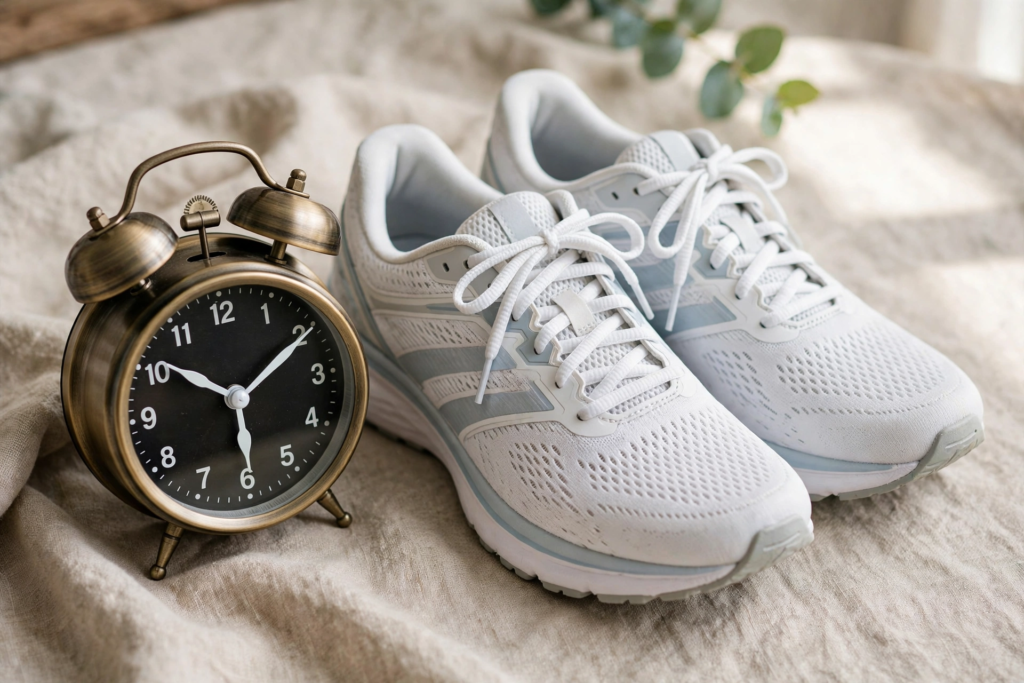
Your Decision Framework: Pick Your Time in Five Steps
**Step 1: Map your non-negotiables.** Write down wake time, work hours, commute, family duties, and bedtime. Cross out every hour that is not genuinely yours. Your realistic training windows are whatever remains.
**Step 2: Check your chronotype.** Alert within minutes of waking? Lean morning. Come alive after sunset? Lean evening. Score each candidate window against your natural energy — a window that fights your biology costs willpower daily.
**Step 3: Protect your sleep first.** A morning window that requires losing sleep is disqualified unless bedtime moves earlier permanently. An evening window pushing intense training within two hours of bed needs to move earlier or stay easy.
**Step 4: Match the window to your goal.** Chasing strength numbers? Favor the later window for the performance edge. Chasing consistency above all? Favor mornings for the adherence edge. General health? Pick the lowest-friction slot and stop second-guessing.
**Step 5: Trial it for two weeks, then judge.** Commit fully to one slot for fourteen days. Track sessions completed, workout quality (1–10), energy, and sleep. Decide with data, not vibes — most people find the answer obvious once they start measuring.
The Bottom Line
The morning-versus-evening debate persists because both sides are right about something real. Mornings offer cleaner schedules, stronger habit formation, daylight for your internal clock, and days that start with momentum. Evenings offer a warmer, more capable body, measurably better strength and power, and a release valve for the day’s stress. The research crowns no universal winner, and any article claiming otherwise sells certainty the evidence does not support. What the evidence does support is simple: train regularly, sleep enough, fuel sensibly, and choose the hour you will actually keep. Run the five steps above, give your choice an honest two-week trial, and let your own numbers settle the argument. The best workout time was never a property of the clock — it is a property of your life.
The content on Knowlix is for informational purposes only and is not medical advice. Always consult a qualified doctor for health concerns.
Sponsored