
Most people assume that living a healthier life requires a dramatic overhaul — a strict new diet, an intense workout plan, or a complete personality change. In reality, the people who feel the best tend to rely on something far simpler: a handful of small, repeatable habits that quietly compound over time. Research on behavior change consistently shows that tiny actions, done daily, beat ambitious plans that burn out by February. A glass of water first thing in the morning, a short walk after lunch, a consistent bedtime — none of these is revolutionary on its own, yet together they shape your energy, mood, digestion, and sleep more than any single “health hack” ever will.
The ten habits in this guide were chosen for three reasons: they are backed by common-sense physiology and widely accepted health guidance, they take minutes rather than hours, and they fit into a normal, busy day. You do not need special equipment, a gym membership, or expensive groceries. Some habits take under a minute. Others simply ask you to rearrange something you already do.
Start with two or three habits that feel easiest, and let them become automatic before adding more. Small wins build momentum, and momentum is what turns a list of good intentions into a lifestyle. By the end of this article, you will have a practical daily playbook — from your first sip of water in the morning to the last minutes before sleep.

1. Wake Up at the Same Time and Hydrate First
Your body’s internal clock, the circadian rhythm, runs on consistency. When you wake at the same time every day — weekends included — your body learns when to release the hormones that help you feel alert in the morning and sleepy at night. People with regular wake times commonly report falling asleep faster, waking with less grogginess, and experiencing steadier energy across the day. It is one of the highest-leverage habits on this list because it costs nothing and quietly improves almost everything else.
After six to eight hours without water, you wake up mildly dehydrated. Drinking water before coffee or breakfast helps restore fluid balance, supports digestion, and can ease the foggy feeling many people mistake for needing more sleep. Keep it simple: one full glass, within thirty minutes of waking.
Set a Consistent Wake-Up Time
- Choose a wake time you can keep seven days a week, and set your alarm for that time even on weekends.
- Place your alarm across the room so you have to stand up to silence it — the movement helps wakefulness kick in.
- Get out of bed within five minutes of the alarm rather than snoozing, since snoozing fragments the last stage of sleep and usually makes you feel worse.
- If you currently wake at wildly different times, shift your alarm earlier by just 15 minutes every few days until you reach your target.
Make Morning Water Effortless
- Fill a glass or bottle of water the night before and leave it on your nightstand or bathroom counter where you will see it.
- Drink the full glass before you check your phone or make coffee, so hydration becomes your first act of the day.
- Room-temperature water is gentler on an empty stomach if cold water feels harsh first thing.
- Add a squeeze of lemon or a few slices of cucumber if you prefer some flavor — just avoid sugary drink mixes that turn a healthy habit into a sugar habit.
2. Move More: Walk Daily and Stretch Often
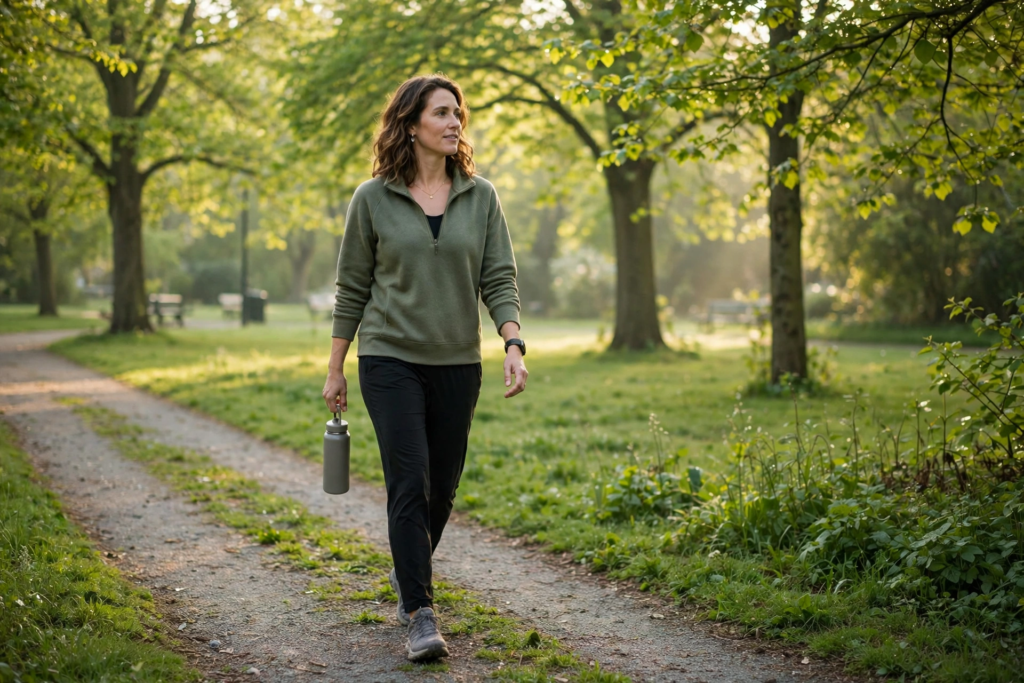
You do not need to train like an athlete to benefit from movement. Regular, moderate activity — the kind that gets you breathing a little faster without leaving you exhausted — supports heart health, joint mobility, mood, and blood sugar balance. Walking is the most underrated exercise in existence: free, low-impact, and easy to weave into a day. Studies of walking programs consistently link a daily walk with better cardiovascular markers, improved sleep quality, and lower stress.
Stretching is walking’s quiet partner. Hours at a desk tighten the hip flexors, hamstrings, neck, and shoulders, which contributes to stiffness, headaches, and poor posture. A few minutes of gentle stretching loosens all of that and sends a signal to your nervous system that it is safe to relax.
Build a Daily Walking Habit
- Aim for a 20 to 30-minute walk most days; if that feels like a lot, start with 10 minutes and add five minutes each week.
- Walk after your largest meal — post-meal walks are especially good for digestion and help smooth out the blood sugar rise that follows eating.
- Break it up if needed: three 10-minute walks across the day deliver real benefits and are easier to fit around work.
- Take calls on the move, park farther from entrances, or get off transit one stop early to bank steps without scheduling extra time.
- Choose a pleasant, consistent route so the walk becomes a ritual you look forward to rather than a chore.
Stretch for Five Minutes, Twice a Day
- Morning: reach overhead, do gentle neck rolls, a standing side bend each way, and a hip-flexor lunge held 30 seconds per side.
- Evening: lie on your back for a figure-four hip stretch, a gentle spinal twist, and child’s pose to unwind the lower back.
- Hold each stretch 20 to 30 seconds and breathe slowly — never bounce or push into sharp pain.
- Stretch after your walks while muscles are warm; it takes two minutes and makes the next day’s walk feel easier.
- Set a reminder to stand and stretch for one minute every hour if you sit most of the day.
3. Eat Mindfully and Build Balanced Plates
How you eat matters nearly as much as what you eat. Mindful eating simply means paying attention — noticing flavors, chewing thoroughly, and tuning in to fullness signals instead of eating on autopilot in front of a screen. Most people eat too fast for their body’s satiety hormones to catch up, which is why slowing down often leads to eating less without feeling deprived. Chewing well also makes the first stage of digestion easier on your stomach.
Balanced plates keep your energy steady. Meals built around vegetables, a source of protein, whole grains or starchy vegetables, and healthy fats digest more slowly than refined-carbohydrate-heavy meals, which means fewer energy crashes and less mindless snacking an hour later. You do not need to count anything — just eyeball the proportions.
Practice Mindful Eating
- Put your phone face-down and turn off the TV during meals; distraction is the number one cause of overeating.
- Take one slow breath before your first bite to shift out of “rushed” mode.
- Put your fork down between bites and chew each mouthful thoroughly — aim for the food to be well broken down before swallowing.
- Pause halfway through your meal and ask yourself how full you feel on a scale of 1 to 10; stop around 7 or 8, comfortably satisfied rather than stuffed.
- Serve yourself a reasonable portion first instead of eating straight from the bag or pot, so you can see how much you have had.
Assemble Balanced Plates
- Fill about half your plate with vegetables — fresh, frozen, or lightly cooked all count, and frozen vegetables are just as nutritious as fresh.
- Add a palm-sized portion of protein such as beans, lentils, eggs, fish, poultry, tofu, or yogurt to each main meal.
- Choose whole grains like brown rice, oats, quinoa, or whole-wheat bread over refined versions for steadier energy.
- Include a source of healthy fat — a drizzle of olive oil, a small handful of nuts, or half an avocado — which helps you absorb fat-soluble vitamins and feel satisfied.
- Keep a colorful mix across the week: different colors generally mean different vitamins, minerals, and plant compounds.

4. Get Morning Sunlight and Fresh Air
Light is the most powerful cue your brain uses to set your body clock. Bright outdoor light in the first hour or two after waking tells your brain to suppress melatonin (the sleep hormone) and start the daytime cycle of alertness hormones. People who get regular morning light exposure tend to feel more awake during the day and fall asleep more easily at night. Indoor lighting, even in a bright office, is typically far dimmer than daylight — which is why stepping outside matters even on cloudy days.
Fresh air and a change of scenery add their own benefits. Short periods outdoors are linked with lower perceived stress, better mood, and a mental reset that improves focus when you return to work. Combined with habit two, a morning walk outdoors lets you stack sunlight, movement, and fresh air into one efficient ritual.
Get Daylight Early
- Step outside within an hour of waking for 10 to 20 minutes; on bright days 10 minutes is enough, on overcast days aim closer to 20.
- Do not wear sunglasses during this morning light session — your eyes need the light signal (never stare directly at the sun).
- Pair it with your morning walk or have your water and coffee on a balcony, porch, or by an open window.
- If you work indoors, take a midday outdoor break too; even five minutes at lunch helps maintain daytime alertness.
- In winter or dark climates, sit near your brightest window during the morning hours as a partial substitute.
Make the Outdoors a Daily Ritual
- Keep a pair of comfortable shoes by the door so a short outdoor break takes zero preparation.
- Open windows at home for at least 15 minutes a day to circulate fresh air, especially in rooms where you sleep and work.
- Take one work break per day outside — a bench, a garden, or just standing on the sidewalk counts.
- Notice something specific each time you go out (a tree changing color, the quality of the light, birds) — this small mindfulness practice deepens the stress-relief effect.
- On weekends, plan one longer outdoor activity: a park visit, a hike, gardening, or a picnic, to bank extra daylight and movement.
5. Take Regular Digital Breaks
The average person now spends hours a day on screens, and while technology is useful, constant connectivity keeps the nervous system in a low-grade state of alertness. Notifications fragment attention, evening screen time pushes bedtimes later, and endless scrolling is strongly associated with worse mood and sleep. A digital detox does not mean abandoning your phone — it means setting deliberate boundaries so screens serve you rather than run your day.
Start with the edges of your day: the first and last hour. Keeping your phone out of the bedroom alone transforms both your mornings and your nights. Then add small screen-free pockets during the day to give your eyes and your attention a rest.
Set Screen Boundaries That Stick
- Keep your phone out of the bedroom at night; use a simple alarm clock instead of your phone alarm.
- Avoid screens for the first 30 to 60 minutes after waking so your morning belongs to you, not your inbox.
- Turn off all non-essential notifications and keep your phone on silent or Do Not Disturb during focused work blocks.
- Designate one screen-free meal per day, even if it is just breakfast.
- Set a daily “phone curfew” — for example, no scrolling after 9:30 PM — and plug the phone in to charge in another room.
Replace Scrolling With Restorative Breaks
- When you feel the urge to scroll, stand up and stretch, look out a window, or step outside for two minutes instead.
- Try a 20-minute screen-free walk at lunch; leave the phone behind or in your pocket.
- Use the 20-20-20 rule for eye comfort: every 20 minutes, look at something 20 feet away for 20 seconds.
- Keep a book, puzzle, or hobby within reach in the evening so relaxation does not default to a screen.
- Track your screen time once a week — awareness alone usually reduces it, and most phones show this in settings.
6. Practice Gratitude and Protect Your Sleep
Gratitude and sleep might seem like an odd pair, but both are about how you end your day — one settles the mind, the other restores the body. A short gratitude practice shifts attention away from rumination and toward what is working, and research on gratitude journaling links it with better mood, lower perceived stress, and even improved sleep quality. It takes two minutes and requires nothing but a pen or a phone note.
Sleep, meanwhile, is the foundation everything else rests on. During sleep your brain consolidates memory, your muscles repair, and your immune system does essential maintenance. Most adults need seven to nine hours, yet a large share get far less. A consistent wind-down routine — the same calming sequence each night — trains your brain to recognize that sleep is coming, the same way a consistent wake time trains it for mornings.
Build a Two-Minute Gratitude Practice
- Each night, write down three specific things you are grateful for — specific beats generic (“the barista remembered my order” beats “coffee”).
- Include at least one thing about your own body or health once a week, like strong legs after a walk.
- If you miss a day, simply resume the next — the benefit comes from the overall pattern, not perfection.
- Share one gratitude out loud with someone you live with; saying it strengthens the effect and often improves the relationship.
- On hard days, allow small and ordinary entries — gratitude is most powerful precisely when life feels difficult.
Create a Sleep Routine That Works
- Go to bed at the same time each night, keeping your wake time from habit one fixed — consistency matters more than the exact hour.
- Start winding down 45 to 60 minutes before bed: dim the lights, switch screens to night mode or off, and move to a calmer activity.
- Keep your bedroom cool, dark, and quiet — blackout curtains or a sleep mask and earplugs are inexpensive upgrades with outsized impact.
- Avoid caffeine after early afternoon; its half-life means an afternoon coffee can still be active at midnight.
- If your mind races in bed, keep a notepad nearby and jot tomorrow’s tasks down — externalizing worries makes them easier to release.
- Get out of bed if you cannot sleep after about 20 minutes; do something calm in dim light, then return when drowsy.
Frequently Asked Questions
How many of these habits should I start at once?
Start with two or three that feel easiest — for most people, morning water, a daily walk, and a fixed wake time are the lowest-friction wins. Trying to adopt all ten at once usually leads to quitting all ten within a week. Once your first habits feel automatic (typically two to four weeks), layer in the next one or two. Slow stacking builds a lifestyle; sprinting builds burnout.
What if I have an irregular work schedule or do shift work?
Consistency matters more than the clock time. If your schedule rotates, anchor your habits to events rather than hours: water right after waking, a walk after your main meal, a wind-down routine before bed. Keep your sleep environment dark and cool, and get daylight exposure during your “morning,” whenever that falls. Adapt the habits to your rhythm instead of abandoning them.
How long does it take for a new habit to feel automatic?
It varies widely by person and by habit — simple habits like drinking water on waking can feel automatic within a couple of weeks, while more involved ones like a daily walk may take a month or two. Linking a new habit to an existing routine (habit stacking) speeds things up: “after I brush my teeth, I drink a glass of water” works better than relying on willpower alone. Missing a day does not reset your progress; just resume the next day.
Do I need any special equipment or products for these habits?
No. Every habit on this list uses things you already have: tap water, your own two feet, ordinary food, daylight, and a bed. Comfortable walking shoes help, and a simple alarm clock is useful if you want your phone out of the bedroom, but nothing here requires a purchase. Be skeptical of products marketed as essential for basic healthy habits.
Can these habits replace exercise or a healthy diet?
These habits complement exercise and good nutrition rather than replacing them. Walking is genuine exercise and balanced plates are genuine nutrition — so you are already covering the basics — but if you enjoy running, strength training, swimming, or sports, keep doing them. Think of these ten habits as the foundation that makes everything else you do for your health work better.
What should I do if a habit stops working or life gets chaotic?
Shrink the habit instead of dropping it. A five-minute walk still counts when thirty feels impossible; one line of gratitude still counts on a hectic day. The goal during chaotic periods is simply to keep the streak of identity — “I am someone who does this” — alive. When life settles, expand back to the full version. Flexibility is what keeps habits alive for years.
You do not need a perfect routine, an expensive plan, or superhuman discipline to live a healthier life. You need a small set of daily habits that are so simple you can do them on your worst day — and the patience to let them compound. Water first thing, a consistent wake time, a daily walk, a few minutes of stretching, mindful balanced meals, morning daylight, screen boundaries, a moment of gratitude, and a real wind-down before sleep: each one is modest, but together they touch every system that determines how you feel.
Start tonight by filling a glass of water for your nightstand and setting one consistent wake time for tomorrow. Add a short walk after lunch. Then keep stacking, one habit at a time. A year from now, you will not remember the day you started — but your energy, your sleep, and your mood will show it. The healthiest life is not built in a weekend; it is built one ordinary day at a time.
The content on Knowlix is for informational purposes only and is not medical advice. Always consult a qualified doctor for health concerns.
Sponsored